
What to Know
- CMS’s 2026 radiation oncology coding overhaul could put significant provider revenue at risk if commercial payer contracts have not kept pace.
- Revised delivery codes may not preserve revenue unless providers request that payers correctly reprice services previously billed across multiple line items.
- Reviewing fee schedules, percentage-of-charge reimbursement, and lesser-of provisions now can help organizations identify costly gaps and protect revenue neutrality.
Earlier this year, the AMA and CMS implemented the most significant overhaul of radiation oncology treatment delivery and image guidance coding in over a decade. These changes affect how external beam radiation therapy (EBRT), intensity modulated radiation therapy (IMRT), and image-guided radiation therapy (IGRT) services are reported and reimbursed across all plans.
For both hospital outpatient departments and physician groups, the downstream payer contracting implications are substantial. Organizations that do not actively review their payer agreements in light of these changes risk significant revenue declines.
Below we’ve highlighted the key structural coding changes, as well as three commercial payer contracting impacts that leaders should assess now.
The Changes
Effective January 1, 2026, CMS made the following major changes to radiation therapy coding:
-
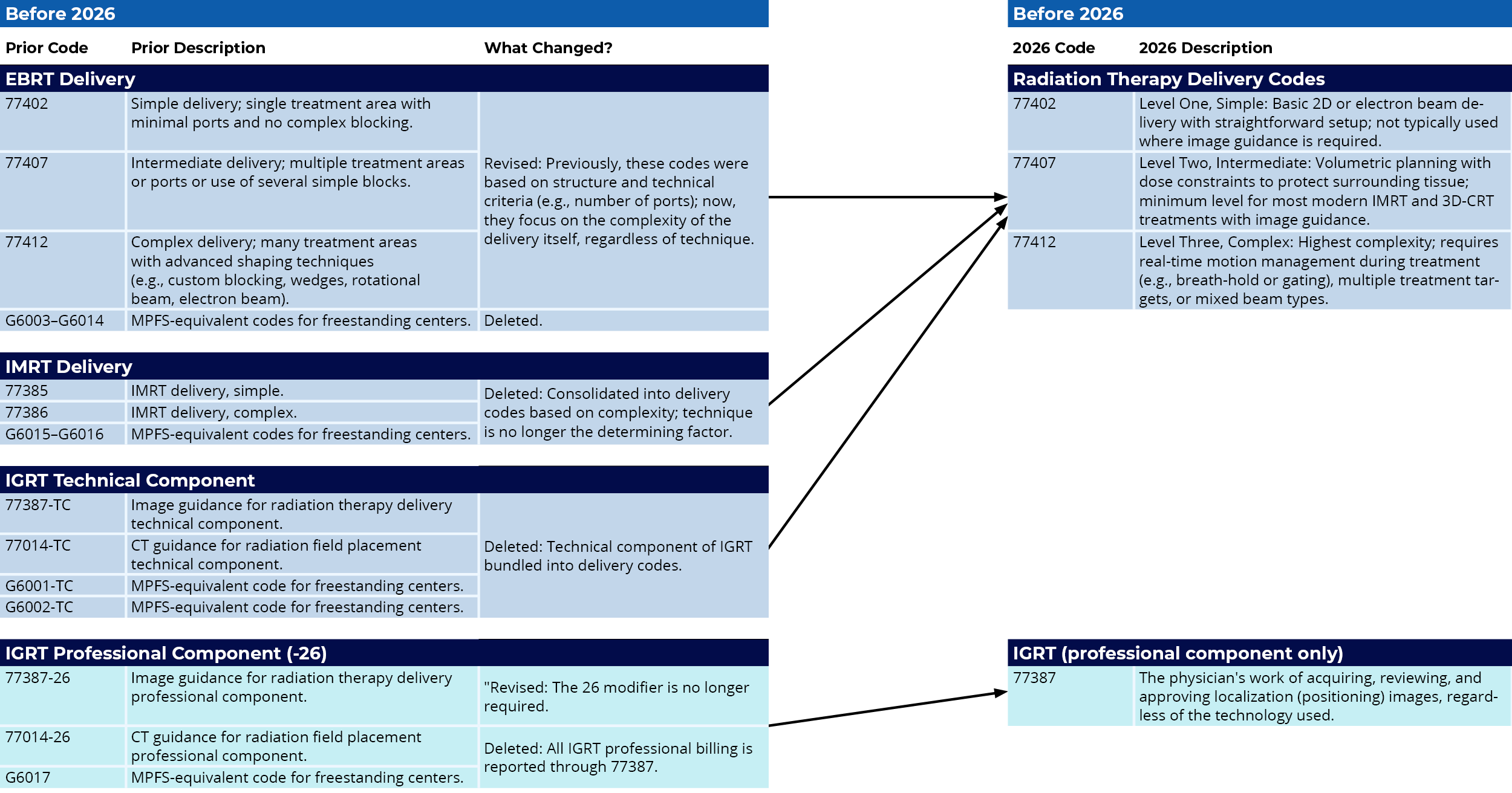
Restructured EBRT delivery codes into three complexity tiers: 77402, 77407, and 77412. These codes were previously based on structure (e.g., single versus multiple treatment areas) and technical criteria (e.g., number of ports), but now they focus on the complexity of the delivery itself, regardless of technique.
-
Deleted IMRT delivery codes (77385 and 77386). IMRT is no longer reported as a distinct code. Instead, IMRT services are captured within the revised 77402–77412 tiers based on delivery complexity.
-
Bundled the technical component of IGRT into the delivery codes.
- IGRT is no longer billed separately as a technical service. Therefore, CMS deleted the following codes that previously comprised IGRT: 77387-TC, 77014, G6001, G6002, and G6017.
- CMS has repurposed 77387 as a professional-only CPT code that represents the physician work of acquiring, reviewing, and interpreting localization imaging. The reporting modifier 26 is redundant, though some commercial payers still require it.
- Updated and increased RVUs to reflect the expanded scope of the revised delivery codes (77402, 77407, and 77412). Because the new delivery codes bundle services previously billed separately, CMS recalibrated RVUs accordingly.
FIGURE 1: Coding Changes Summary
The Impact
Providers should treat the 2026 coding changes as a catalyst for change, not just a billing update. The goal should be revenue neutrality at a minimum, ensuring that reimbursement under the new simplified structure captures what was previously reimbursed across multiple line items.
CMS’s increase in RVUs was intended to offset the consolidation of delivery, IMRT, and IGRT technical codes into the single delivery code; however, that offset only holds if commercial payers have correctly repriced the new codes. Where they have not, provider organizations are forced to absorb both the line-item reduction and a pricing shortfall simultaneously.
To help mitigate potential issues, monitor the three impact areas below.
1. Fee Schedule Alignment
- Payer Proprietary Fee Schedule: If your contract pays on a payer-maintained schedule rather than a direct CMS crosswalk, the payer may not have updated its rates to reflect the new radiation therapy code definitions and RVUs. While the code number remains the same, the updated 2026 description represents a materially more complex, higher-resource service. It is unlikely that commercial payers have repriced these codes for 2026, so it is critical to:
- Confirm each payer’s current rates for 77402, 77407, and 77412.
- Compare the identified rates against the expanded 2026 code definitions.
- Negotiate updates for codes the payer has not repriced.
- Outdated CMS Base Year: If your contract pays on an older percentage of Medicare fee schedule (i.e., 2025 or earlier), the underlying RVUs predate the 2026 restructuring. Alternatively, the base rate may not exist at all (as is the case for 77387 on the MPFS before 2026). In these cases:
- Collaborate with the payer to establish how these revised codes will be valued.
- Negotiate a rate adjustment where applicable.
2. Percentage-of-Charge Reimbursement
If any payer reimburses on a percentage-of-charge basis, update your CDM charges for these codes to reflect the higher RVU weight of the 2026 definitions. Because the revised delivery codes now bundle services that were previously billed separately (i.e., IMRT and IGRT), the appropriate charge for a given episode of care has changed, even if the clinical service has not. Failure to update charges means percentage-of-charge reimbursement will understate the value of services rendered, leading to a revenue loss that compounds with volume. Hospitals may also be hampered by CDM contractual language that limits CDM increases to 0%, as an example.
3. Lesser-Of Provisions
Many payer contracts include a lesser-of clause—typically, the lesser of billed charges or the contracted rate. For codes where the 2026 RVU revaluation produces a higher contracted rate than your current billed charge, the lesser-of calculation will cap reimbursement at your charge rather than the contracted rate. This is most likely to affect 77407 and 77412, where the bundling of previously separate services has increased RVU value. In instances where the contracted rate now exceeds the CDM charge, update the charge, because even when payers correctly reprice the code, stagnant charges leave money on the table.
The Call to Action
ECG has each of these scenarios playing out in real time across our hospital and physician group clients. Payer fee schedules that have not been updated, CDM charges that have not kept pace with bundled code values, and lesser-of provisions quietly capping reimbursement are collectively costing providers millions of dollars in reduced reimbursement. While taking action may require some difficult negotiations with commercial and MA payers, provider organizations that move quickly to identify and correct these gaps are best positioned to achieve revenue neutrality under the new structure.
Learn how ECG’s payer contracting team can help you assess reimbursement risks and identify opportunities to protect revenue.