
AI is increasingly being deployed to support healthcare operations. So the question is no longer about whether it’s coming; it’s about who is ready to move beyond early adoption.
ECG recently surveyed healthcare organizations around the country to understand how they are using AI today and/or what may be holding them back. The findings, based on responses from 70 health systems of various sizes, point to a landscape that is actively exploring AI use cases but is not yet confident, with many organizations still trying to separate the signal from the noise.
For Health Systems, Delayed Action Does Not Yet Mean Missed Opportunity
Across respondents, AI initiatives are less than two years old. That means most health systems are still in discovery mode, despite the level of attention AI is getting at the executive and board levels.
The survey respondents span organizations and stakeholder perspectives across the spectrum: from small community hospitals to large integrated delivery networks, with representation across clinical, operational, and IT leadership domains.
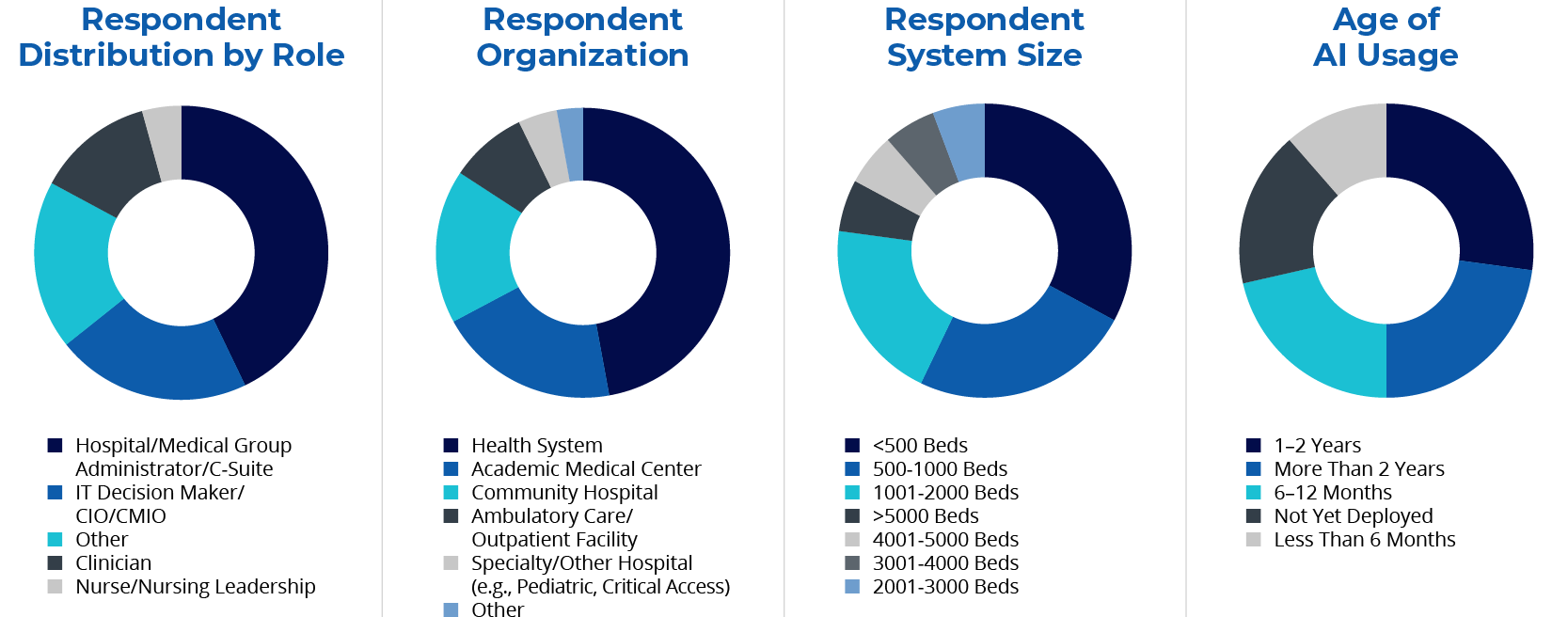
Despite the variability in the composition of respondents, the results are remarkably consistent.
Adoption today is concentrated in low-risk, high-volume workflows such as scheduling, billing, and patient access. More advanced use cases are being discussed but not as widely implemented.

Everyone Wants Proof. Almost No One Has It.
When asked what would accelerate AI adoption, respondents cited the need for case studies from peer organizations to better understand the critical success factors and proven implementation approaches. They ranked peer case studies above product demonstrations, implementation support, and regulatory guidance, underscoring a desire for evidence, proven outcomes, and lessons learned from organizations that have already navigated the adoption journey.
Hard evidence, however, is in short supply.
While AI technology continues to advance rapidly, adoption remains driven by trust and demonstrated value.

At the same time, a barrier to adoption is the issue of how closely an AI strategy aligns with legacy investments. The majority of respondents reported using the three market-leading EHR platforms: Epic, Oracle Cerner, and Meditech. When evaluating AI opportunities, health systems often start with the capabilities embedded in their current EHR platforms and the AI roadmaps of their EHR vendors.
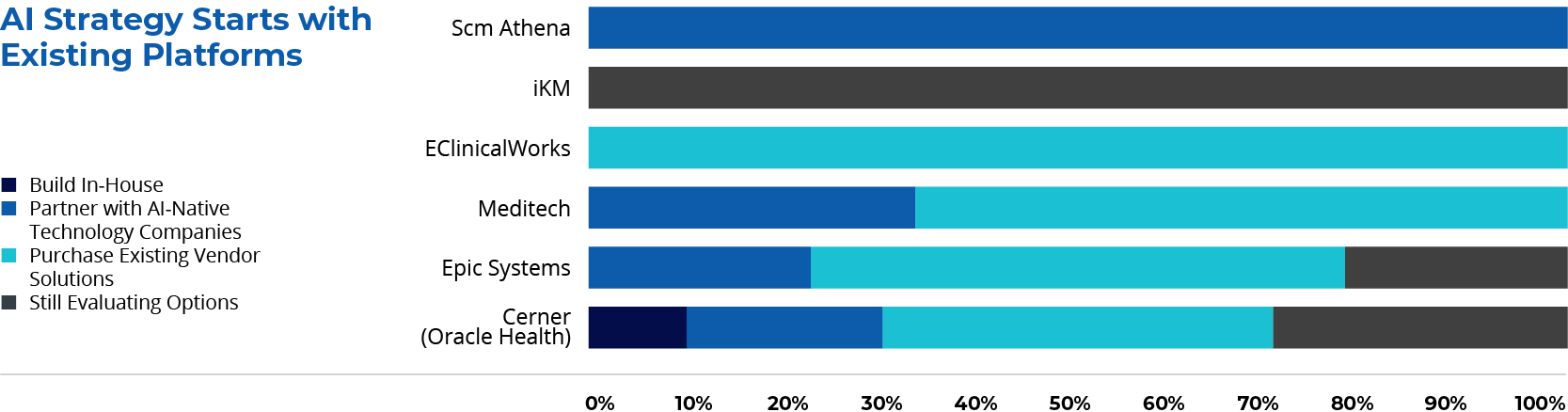
While interest in AI remains high, many organizations are approaching adoption pragmatically. Leaders are weighing the potential benefits of new AI use cases against the realities of integrating with legacy applications, ensuring interoperability across the technology ecosystem, managing organizational change, and rationalizing existing technology investments. Success depends not only on the technology itself, but on an organization’s readiness to incorporate it effectively into existing workflows and operations.
These are not just technology issues. They point to a need for clearer direction and governance.
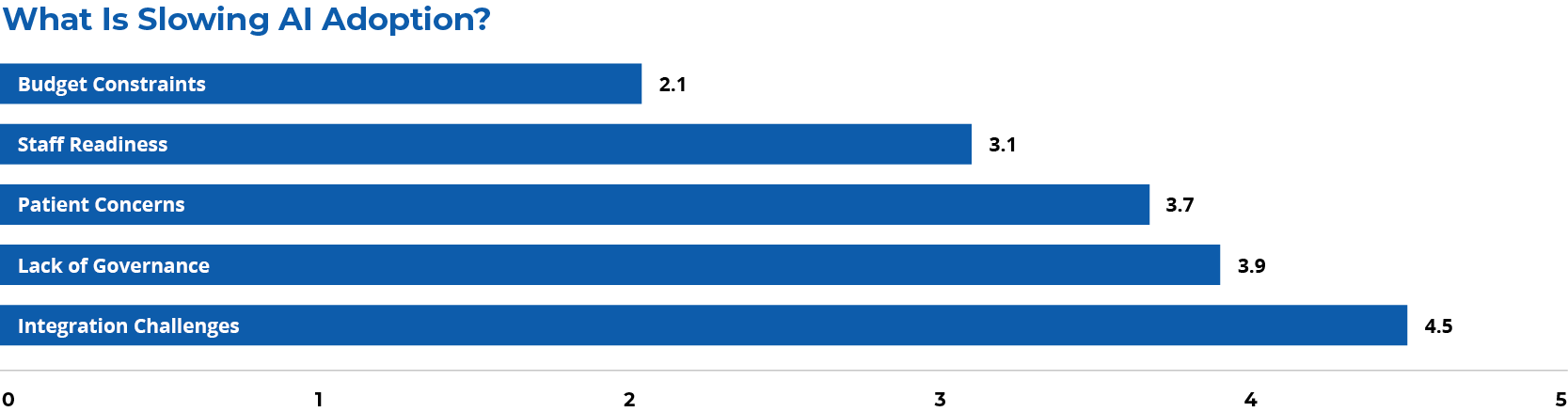
The Market Is Moving Faster Than Decision-Making Frameworks
There is no shortage of AI tools. The perceived gap is a set of clear, repeatable ways to evaluate and adopt them.
Organizations are being asked to make decisions about:
- Whether to rely on existing vendors or introduce new ones.
- Which use cases actually justify investment.
- How to measure value beyond initial pilots.
Without structure, these decisions become reactive and inconsistent. As the market evolves, organizations that can connect strategy, technology, and operational execution will be best positioned to realize AI’s full potential.
What Comes Next Will Separate Leaders from Everyone Else
Right now, healthcare leaders are navigating two realities at once. They are being asked to move quickly, while facing limited proof from peers and few clear frameworks for making decisions. That gap is where many organizations stall.
This post highlights a few early findings from our survey. In our forthcoming full report, we’ll go further into what leading organizations are doing today and how organizations can make these decisions.
Ready to move from AI uncertainty to informed action?
ECG helps health systems bring structure to AI strategy, governance, and vendor decisions, backed by the Cipher Collective, which combines curated AI solutions with advisory guidance.