
Too often, strategic facility planning begins only after a major capital project creates urgency. In other words, the planning conversation only becomes “real” once space is involved.
This reactive approach can obscure the most valuable aspects of the process. A strategic master facility plan is not simply a roadmap for future capital investments. It serves as a system integration tool that aligns strategy, operations, service lines, and leadership around a shared vision for how care should be delivered.
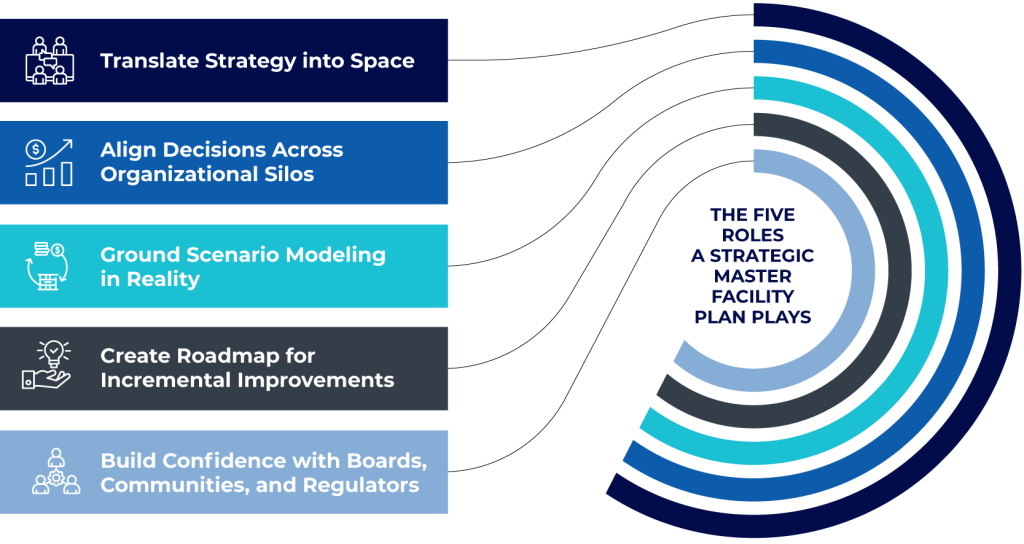
Used effectively, a strategic master facility plan plays five interconnected roles:
Role 1: Translate Strategy into Space
Effective strategic master facility planning begins with a question that is often underdeveloped in traditional strategy work: how will care be delivered in the future? Not in the abstract, but in terms of where patients enter the system, how they move through it, and which settings are expected to absorb growth.
External constraints force that clarity. One California-based health system expects to lose a portion of its inpatient capacity because of seismic regulations. Instead of defaulting to replacing those beds, the organization is using the planning process to redefine how care is delivered and to shift appropriate services from inpatient into ambulatory settings.
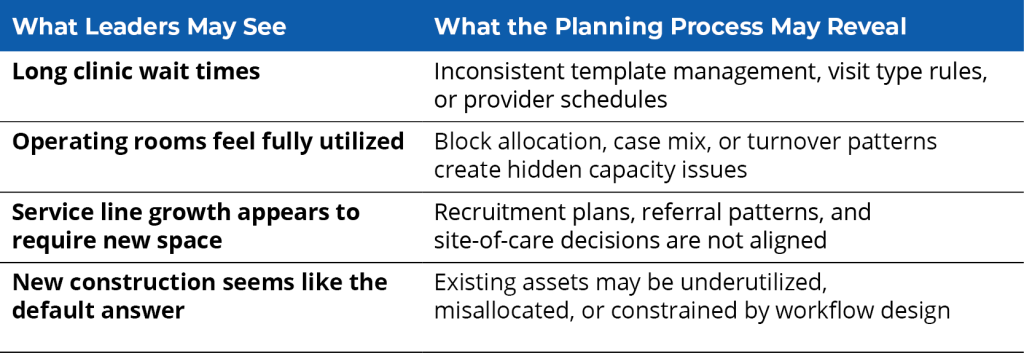
In this instance, the facility plan is being used to rethink the hospital’s role within the broader care continuum. And it demonstrates a broader benefit of the facility planning process: it helps leaders determine whether an apparent facility constraint is truly a space problem or a symptom of a deeper operational issue.
Role 2: Align Decisions Across Organizational Silos
One of the most underappreciated benefits of a system-wide strategic master facility plan is its ability to align functions that typically plan in parallel rather than together. Strategy, finance, operations, IT, and physician leaders are all accustomed to making internally rational decisions within their own domains. But those decisions don’t always add up to a coherent system plan.
In one West Coast system, strategy and finance teams were operating from different volume forecasts. Each forecast was internally sound, but they were developed in isolation and not cross-referenced. That misalignment may have had limited day-to-day impact, but once translated into a facility plan, it became flawed. The organization could not meaningfully plan capacity, sequencing, or capital without first reconciling a single view of future demand based on a shared agreement of priorities.
The planning process exposed the issue and forced the organization to resolve it. In a capital-constrained environment, such alignment is essential. Leaders must agree on prioritization, sequencing, and operating assumptions.
Role 3: Ground Scenario Modeling in Reality
Most health systems engage in scenario planning, but those exercises often remain abstract, testing assumptions without defining what those changes require operationally. The value is not simply in testing different futures, but in understanding how prepared the system is to operate within them.
Consider the continued shift from inpatient to outpatient care. The strategic master facility plan requires leaders to determine which services can realistically move, where capacity exists to absorb them, and what constraints (e.g., clinical, operational, regulatory) stand in the way.
In this way, competitive pressures are no longer evaluated only in terms of market share, but in terms of whether the system can respond using its existing footprint. The planning process exposes gaps between what the organization intends to do and what it is currently equipped to support. It highlights where flexibility exists, and where it does not, before those constraints are encountered in real time.
By evaluating scenarios through the lens of both physical space and operational capacity, the strategic master facility plan helps organizations identify vulnerabilities early and respond more deliberately.
Role 4: Create a Roadmap for Incremental Improvements
Leaders often assume it takes $200 million, or at least a major capital approval cycle, to make meaningful progress. In many cases, it takes closer to $2 million. A large capital project may still be the long-term goal, but a strategic master facility plan shows how to move the system forward in smaller, more immediate ways.
In this context, repurposing a suite, consolidating a service, or shifting capacity between sites becomes more than a tactical fix. It supports a broader effort to realign the system with its intended (or desired) model of care. This is where the “roadmap” becomes tangible. Instead of waiting for a single, defining project, organizations begin to make a series of targeted moves that compound over time.
- Underutilized space is reassigned to services that are consistently constrained.
- Clinics are adjusted to better reflect how patients enter the system.
- Capacity is added selectively, where it supports both access and clinical priorities, rather than where space simply happens to be available, or is awarded to the squeaky wheel.
Role 5: Build Confidence with Boards, Communities, and Regulators
Boards, communities, and regulators are less concerned with whether projects are advancing than with whether the organization has a coherent, defensible plan for using its existing assets.
A system wide strategic master facility plan provides that coherence. By articulating how services are distributed, where growth is prioritized, and how constraints are being actively managed, leadership can communicate decisions with greater confidence and consistency. The plan shifts conversations away from isolated requests and toward an integrated system narrative.
With a documented plan, leaders can demonstrate that choices are being made deliberately, even when those choices involve maintaining, reallocating, or optimizing existing space rather than building new facilities. The strategic master facility plan becomes more than an internal planning tool. It functions as a governance and accountability mechanism, reinforcing trust by making priorities, tradeoffs, and constraints explicit.
Making the Facility Plan a Leadership Tool
Ultimately, the value of facility planning is not measured in square footage or capital deployed. It is measured in the quality of decisions it enables, even if the results is not a new building. By connecting strategy, operations, service distribution, and capital priorities, the plan gives leaders a tangible framework for reconciling competing assumptions.
In an era defined by financial constraint, workforce pressure, and shifting care models, the question for health system leaders is not whether new facilities can be built. It is whether the organization has sufficient clarity to deploy its existing assets deliberately. A system-wide strategic master facility plan helps create that clarity, preparing the organization to act decisively when conditions change, rather than reactively when they do.